Stepping off the grid in a recreational vehicle brings unparalleled freedom, but it also strips away your suburban safety net. When you are miles deep into public lands, no local fire departments are rushing to save your rig. An accidental spark can reduce an RV to ashes in under ten minutes. Knowing the RV fire prevention tips is helpful for fire safety in small spaces.
For BoonDockers, RV fire prevention isn’t just a box to check; it is a critical survival skill. Many remote travelers rely on dangerous myths or old-school methods for emergencies. Our guide breaks down the essential principles of fire safety in small spaces, debunks common extinguishing myths, and explores how modern technology can protect your home on wheels.
The Hidden Danger of Fire Safety in Small Spaces
When you are living in an RV, it is difficult to navigate the environment, which has tight footprints. In a brick and mortar home, the situation is different than the RV houses that are built with materials that are combustible, such as plywood, fiberglass, and polyurethane foam. On top of that, there would be an immediate fire spread due to 12V electrical joints, a compact kitchen, and propane pipelines.
True fire safety in small spaces requires understanding that you have seconds, not minutes, to react. In a confined layout, thick toxic smoke fills the ceiling space almost instantly. If a fire breaks out while you are sleeping or distracted outside, manual defense options quickly become useless. This makes proactive preparation your absolute best line of defense.
Off-Grid Kitchen Safety: Preventing the Cooking Flare-Up
Kitchen operations represent the number one source of open flames inside a mobile rig. Practicing strict off-grid kitchen safety means recognizing the volatile nature of propane-powered cooktops. Propane burns hotter than natural gas, and the localized drafts inside an RV can cause flames to flicker violently near curtains or paper towels.
Never leave a cooking pan unattended. When you are boondocking, it is easy to step outside to check your solar panels or enjoy the view. It only takes a brief moment of distraction for cooking oil to reach its auto-ignition temperature. To maintain safety, clear all cooking spaces of grease buildup regularly, keep flammable fabrics pinned away from the stove, and ensure your ventilation fans are clear of debris.
RV Kitchen Grease Fire Protection: Defending the Cooktop
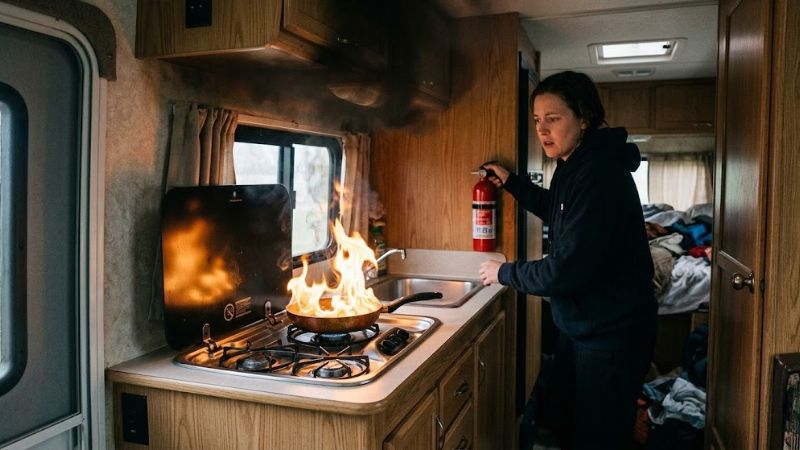
When a cooking pan overheats, it triggers a Class B grease fire. As established, throwing water of any temperature on a grease fire is a critical mistake. Because water is denser than oil, it immediately sinks to the bottom of the pan, instantly vaporizes into steam, and expands to over 1,700 times its original size. These forces burn oil outward into the small cabin, causing severe burns and setting the walls on fire.
Effective RV kitchen grease fire protection requires a non-liquid approach if handled manually. The safest manual step is to slide a metal lid over the pan to suffocate the flame, then turn off the propane supply. However, if the flare-up is too intense to approach, you must rely on tools specifically rated to handle oil and chemical fires without spreading the hazard.
Choosing the Best Fire Extinguisher for RV Use
Every off-grid vehicle must carry portable extinguishers, but not all models are created equal. When shopping for the best fire extinguisher for RV travel, skip the standard residential models. Look for a heavy-duty, Triple-Rated Class A:B:C dry chemical or clean-agent extinguisher.
- Class A: Handles wood, paper, and fabrics.
- Class B: Suppresses burning liquids, grease, and propane gas.
- Class C: Safely puts out electrical fires without conducting shocks to the user.
Mount at least one extinguisher near the exit door and another in the sleeping area. Remember, manual extinguishers require you to be calm, trained, and close enough to fight the flame. If a grease fire breaks out, the toxic chemical powder from a traditional extinguisher can ruin your RV’s interior and electronics completely, making cleanup a nightmare.
Can Boiling Water Put Out a Fire? Misconceptions Debunked
When resources are scarce during a boondocking trip, travelers often think creatively about what is on hand. Imagine a small flame erupts on your cooktop while you are boiling pasta. A common question arises: can boiling water put out a fire?
However, answering ” yes” to the question of whether boiling water can put out a fire with a blanket is incredibly dangerous for an off-grid traveler. If that flame is located on your stovetop and involves cooking oil or grease, throwing any water on it will cause an immediate, catastrophic explosion.
The Ultimate Solution: Compact Fire Suppression Systems
For ultimate peace of mind while exploring the backcountry, passive defense beats manual intervention every single time. A compact fire suppression system acts as an invisible, automated firefighter that protects your rig 24/7, even when you are asleep or away from the vehicle.
The FireBot Flex Systems are specially designed for the compact boundaries that have high-vibration environments of mobile travel. This battery-operated unit mounts discreetly under your rangehood without complex wiring or plumbing.
Using advanced thermal sensors, FireBot constantly monitors your cooktop. If an out-of-control flame is detected, it automatically discharges a targeted, non-toxic, 100% biodegradable liquid suppressant. It smothers the grease fire, rapidly cools the surface, and leaves behind a surfactant barrier to prevent dangerous reflashes, all without damaging your cabin or leaving behind corrosive powder.
Conclusion
Navigating the off-grid lifestyle successfully requires respecting the unique safety challenges of mobile living. True off-grid safety relies on robust preventative habits, carrying the right tools, and installing automated protection like FireBot to stop fires instantly at the source.
Ready to secure your mobile home with the ultimate off-grid defense? FireBot Suppression offers the leading compact fire suppression system designed specifically to provide RV kitchen grease fire protection without the mess. Guard your investment and enjoy true boondocking peace of mind. Call our team at (888) 271-3473 to order your automatic safety system today!
Frequently Asked Questions
Why is a standard home fire extinguisher bad for an RV kitchen?
Standard home extinguishers often use corrosive dry chemical powders. When discharged inside a tight RV cabin, the powder creates a blinding cloud, can cause respiratory irritation, and destroys sensitive 12V electronics and wiring, causing irreversible secondary damage.
Can boiling water put out an RV propane fire?
No. Propane fires are pressurized gas fires. Boiling water will not stop the flow of gas or extinguish the flame. To stop a propane fire, you must immediately shut off the main valve at your RV’s propane tank.
How does a compact fire suppression system handle RV vibration?
Premium systems like the FireBot Flex are specifically engineered for mobile adventures. They feature rugged, wireless, and battery-operated components that withstand constant road vibrations without triggering false alarms or suffering mechanical failures.
Where is the most common place for an RV fire to start?
While engine bays and 12V battery compartments are risks, statistics show that the kitchen cooktop remains the leading source of RV fires due to open propane flames, high heat, and splattering cooking oils.
What should I do immediately if an RV grease fire starts?
If it is safe, slide a metal lid over the pan to cut off oxygen and turn off the burner stove. Never throw water on it, and never attempt to carry the burning pan outside, as this will spread the fire instantly. If it is out of control, evacuate immediately.